CHU CI · A FIRST READING
How to read Li Sao: begin with the speaker, then follow the journey
You do not need to identify every ancient name before you can begin. Start with the person speaking, notice what they value, and ask what changes as the poem moves.
帝高阳之苗裔兮,朕皇考曰伯庸。The opening names an ancestral connection and the speaker's father. Begin by asking why a poem starts with a claim about who is speaking.
1. Read one passage, not a list of allusions
Li Sao belongs to the Chu Ci, often called Songs of Chu, and is traditionally attributed to Qu Yuan. A first encounter can feel crowded: ancestors, plants, rulers, chariots and distant places all arrive in the same voice. Treat one passage as a complete reading task. What does the speaker say? What do they want? What makes that difficult?
Fangci begins with the opening passage in Chinese and English. Read the translation once for the movement of the argument, then return to the Chinese lines. Pinyin helps you sound out characters in modern Mandarin; it does not reconstruct the poem's ancient pronunciation.
2. Watch the speaker build a self
The opening connects ancestry, a name and an inner sense of worth. These are choices in a poem, not simply facts to copy into a biography. Keep the speaking voice distinct from later accounts of Qu Yuan's life. Ask how the speaker wants to be recognised, and which details make that claim convincing.
Write down one concrete action and one quality the speaker claims. This small comparison is more useful on a first reading than trying to settle every question about the poem's composition or date.
3. Follow the plants before identifying species
Fragrant plants can be worn, gathered, cultivated or offered. Those verbs matter. A plant on the body helps describe a self; cultivation can suggest care over time; a gift turns attention towards another person. Look first at what an image does in its sentence.
Ancient plant names do not always map neatly to modern species. Early commentaries can disagree, and a modern photograph cannot resolve that disagreement by itself. Use illustrations as an aid to imagining the passage, then read the accompanying uncertainty and source notes.
4. Read the journey as a sequence of choices
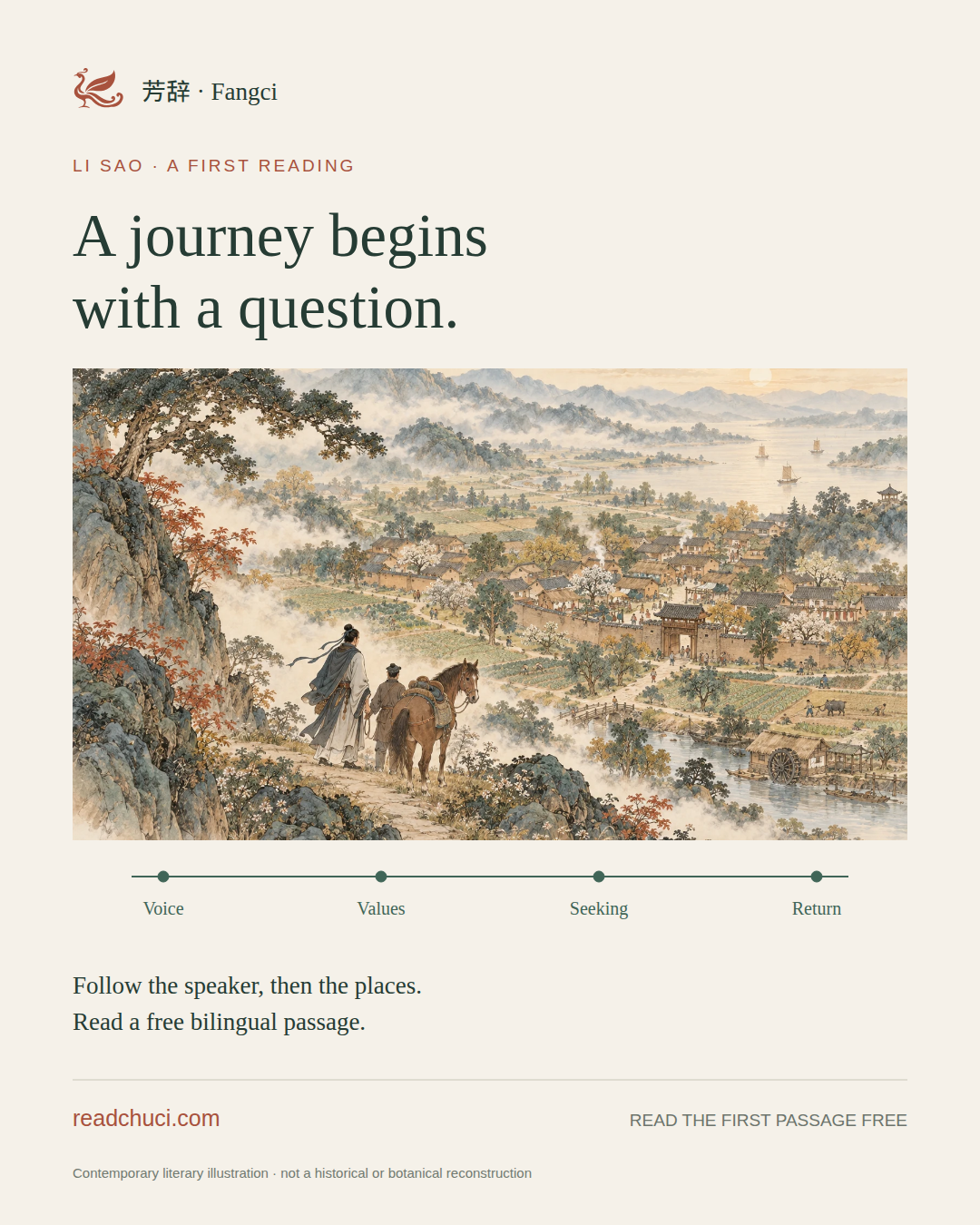
As the poem develops, imagined travel gives the speaker new ways to seek recognition and companionship. Before pinning a place to a modern map, ask what happens there: an approach, a delay, a refusal, another departure. The movement from one scene to the next carries the reading.
Fangci's journey view is a guide to this literary sequence, not evidence that Qu Yuan physically travelled the illustrated route. Keep real waterways, mythic places and uncertain identifications distinct.
5. End your first reading with a question
After the free opening passage, try explaining in your own words what the speaker values and how they present it. Then choose one word or image whose note changes your understanding. A successful first reading leaves you with a clearer question, rather than the feeling that every reference has been solved.
Every poem's first passage is free on Fangci. A one-time purchase opens the remaining passages and the complete reading resources. Read the free passage before deciding; the purchase page shows your current price and the scope of access.